Thursday, September 2, 2010

Investing in Tropical Trees as Renewable Energy

Typical Hardwood Pellets
Some people worry about making an investment in tropical trees, because they can’t predict what economic conditions might be like in 10 year’s time. Fear of another recession or economic slow-down with a consequent possible decline in lumber, building material, pulp or furniture sales has them worried. What they don’t understand is that tropical trees can be a recession-proof investment, because there are so many uses for them. They aren’t thinking about the fact that tropical trees are an excellent source of renewable energy. Power plants need to produce electricity and homes need to be heated in North America and Europe, regardless of economic conditions. Many governments around the world are legislating that power plants use renewable energy sources, at least for a percentage of their fuel requirements. Answering that call are wood pellets, which are almost carbon neutral, cost less than other fuels per heat unit produced, and are a complete renewable energy product. So let’s ignore the fact that demand for tropical hardwoods has consistently exceeded supply since the 1940’s; let us instead focus on tropical trees as a source of renewable energy. To do so we need to know some numbers.

40 lb Wood Pellet Bag
Fast growing tropical trees can reach maturity in just 10 years time, with each harvest immediately followed by replanting. A typical hectare (2.47 acres) of plantation wood at harvest can yield around 500 cubic meters (211,888 board feet) of wood. Depending on the species this can translate into anywhere from 347 to 600 metric tons (382 to 662 US tons) of woody biomass. However, that is only a lumber calculation, as production of wood pellets allows one to use additional biomass such as branches, bark, roots and stumps, easily adding another 25% to the above numbers. The next issue is calorific or BTU value, in other words how much heat does a kilogram of wood produce. There is a great difference between wood types. What is important to note is that the hardwoods growing in a typical tropical tree plantation like Amazonia Reforestation can have high calorific values. For example, Acacia mangium has a calorific value of 4,900 kCal/KG (8,800 BTU/lb), while Eucalyptus pellita has a calorific value of 4,800 kCal/KG (8,640 BTU/lb). That makes these woods not only useful as potential firewood sources, but of great value for the manufacture of wood pellets. Bottom line, managed plantations can produce significant quantities of valuable calorific biomass for renewable energy purposes.

While North American utility companies are often slow to take up alternative energies, European power plants have been implementing wood pellet use as a renewable energy fuel for some time now. In North America wood pellets have seen their greatest use for home, condominium and warehouse heating, with owners installing special wood pellet burning stoves and heaters to get away from the high cost and environmental problems associated with natural gas, LP gas, coal or heating oil. This may be about to change, as North American governments are starting to mandate the use of a percentage of renewable energy sources in power and heat generation plants. In part, this is to get away from the high cost and environmental problems associated with dependence on non-renewable fuels like oil, natural gas and coal. Wood pellets stand out, because they do not require agricultural crops to be turned into bio-diesel or ethanol, at the expense of human food production. Pressure from consumers and governments to convert to renewable energies like wood pellets, geo-thermal, solar and wind sources is likely to grow in the coming years, further increasing the demand for hardwood products. This makes now the perfect time to purchase some tropical trees, as a green investment today will pay off handsomely in the near future.

Sunday, August 22, 2010

Eucalyptus pellita: Our Red Mahogany Tree

Eucalyptus pellita exhibits rapid growth!
Eucalyptus pellita is one of the most popular plantation tropical tree species. It has all of the requirements for a commercially successful timber tree, including rapid growth under plantation conditions, straight stems with limited branching and decent wood quality for particular uses and products. Plantation species should also be tolerant of a variety of soils and location conditions, and be resistant to common pests and diseases, requirements Eucalyptus pellita meets readily. Eucalyptus pellita is marketed as red mahogany or large-fruited red mahogany because of its attractive lumber, though it is equally popular as a source tree for the pulp and paper industry. Eucalyptus pellita is tolerant of poor, infertile soils and will grow in sandy or rocky soils, provided they are well drained.

Eucalyptus pellita has distinctive red and green leaves!
A medium height tropical tree, Eucalyptus pellita can grow to be 40 meters or some 130 feet in height, and  measure approximately 1 meter or 40 inches in diameter at breast height in just 10 years time. The pulp and paper industry harvests this tropical tree after just 7 or 8 years, or when it reaches 35 meters or 115 feet in height. Eucalyptus pellita prefers locations ranging from sea level to 800 meters or 2,625 feet above sea level, with mean annual temperatures from 14⁰ to 34⁰ degrees Celsius (57⁰ to 94⁰ degrees Fahrenheit), and annual rainfall ranging from 900 to 4,000 mm (35.5 to 157.5 inches). The trees preferences are readily met at the Amazonia Reforestation and CO2 Tropical Trees plantations, which are on average 60 meters above sea level, with a mean annual temperature of 26⁰ degrees Celsius or some 80⁰ degrees Fahrenheit, and blessed with 2,400 mm (95 inches) of mean annual rainfall.

Eucalyptus pellita trees at the La Pedregoza tropical tree farm.
Extreme size increases are a feature of Eucalyptus pellita, which is known to achieve growth well in excess of 2 meters a year. Some of the trees planted by Amazonia Reforestation have achieved growth in excess of 6 meters in just their first 12 months after transplantation from our tropical tree nursery. Eucalyptus pellita production rates average 40 cubic meters of wood per hectare per annum, though better managed forestry operations can have production rates exceeding 50 or even 60 cubic meters of wood per hectare per annum. This fast growth is of course important not just from a wood investor’s point of view, but also because of the high carbon sequestration it implies, as discussed at the CO2 Tropical Trees web site.

Eucalyptus pellita wood is marketed as red mahogany.
This exotic wood has numerous potential uses. A full description of Eucalyptus pellita is available in PDF  e-book format for free download at the Amazonia Reforestation web site. Like many of our tropical trees, Eucalyptus pellita is a superb money maker for those making a green investment. It can easily earn returns on investment of 340% over 10 years and do something good for the planet at the same time, because of the tree’s carbon sequestration and cloud seeding properties. All of the plantation pictures in this posting are from our La Pedregoza tree farm in Vichada, Colombia.

Sunday, July 11, 2010

How much carbon does a tropical tree sequester? (Part 2)

Woody biomass is 50% carbon in tropical trees
Continuing from Part 1 (previous Post), let me cite some additional studies and methodologies. A Dutch study entitled “Estimation of Tropical Forest Biomass for assessment of Carbon Sequestration using regression models in remote sensing in Berau, East Kalimantan, Indonesia” by Irvin K. Samalca, Alfred de Gier and Yousif Ali Hussin, of the Department of Natural Resources at The International Institute for Geoinformation Science and Earth Observation confirms and shows that 50% plus of a tropical tree’s woody biomass is carbon. That means that fast growing tropical trees like those planted by CO2 Tropical Trees and Amazonia Reforestation, which reach maturity in just 10 years, are excellent carbon storage vessels.

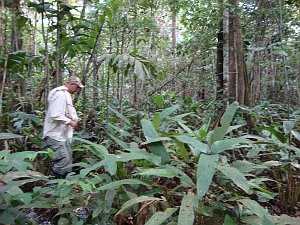
Dexter Dombro observing biomass increase in 11 month old Eucalyptus trees
Let’s calculate this from a different perspective. We know from several studies  that the woody biomass of a tropical tree plantation can increase by at least 35 cubic meters plus (14,382 board feet) per hectare per year. Depending on the hardwood species, one cubic meter (424 board feet) of tropical hard wood can weigh from 600 kg to 1,200 kg (1,322 lbs to 2,645 lbs). Assuming 1 hectare of trees with a gain of 35 cubic meters of wood times a conservative average of 750 kg (1,653 lbs) per cubic meter, and you get 26,250 kg (57,871 lbs) per hectare per year. If at least half of that woody biomass is carbon, then one gets 13,125 kg (28,935 lbs) of carbon. Divide 13,125 kg of carbon by an average of 600 mature plantation trees (after culls) and one gets 22.6 kg (50 lbs) per tree, the number used by CO2 Tropical Trees.

View of natural tropical forest canopy absorbing carbon
Why conservative? There is ample scientific support for much higher carbon sequestration rates by tropical trees. For example, Reforest the Tropics is an applied research program in Costa Rica demonstrating climate change mitigation through sustainable farm forestry. Using a 40 year base line they suggest that a natural tropical forest can sequester between 100 US tons to 160 US tons of carbon per acre (90.7 metric tons to 145 metric tons). This translates into 224 metric tons to 356 metric tons per hectare stored in a natural tropical forest over 40 years. Their research also suggests that a managed plantation of tropical trees will store as much as 800 US tons of CO2 per acre (725 metric tons). That translates into 1,792 metric tons per hectare. If one were to take 1,792,000 kg and divide by 40 years and then divide again by 1,250 tropical trees planted per hectare one would get 35.85 kg (79 lbs) per tree per year.

CO2 Tropical Trees bumber stickers are on cars all over the world!
CO2 Tropical Trees is actually relying on the most conservative estimates of carbon sequestration for its carbon neutral program. They are not alone in relying on those numbers. For example, Carbonify has a carbon calculator that is based on 22.6 kg or 50 lbs of carbon per tropical tree per year. Another example is the article by James Post, citing a 2005 study in Wikipedia that uses 22.6 kg or 50 lbs of carbon sequestration per tropical tree per year for the purpose of calculating carbon offsets. In conclusion all I can say is that every time someone funds the planting of a tropical tree with CO2 Tropical Trees or with Amazonia Reforestation, the very least they can expect from that tree is 22.6 kg or 50 lbs of carbon sequestered per year from our atmosphere. Given these facts and numbers people and institutions really don’t have any more excuses for not funding tree planting as an obvious partial solution to climate change.

How much carbon does a tropical tree sequester? (Part 1)

Dexter Dombro at experimental native tree plantation
Some people have asked me what evidence there is to support the claim by CO2 Tropical Trees that the average tropical tree will sequester 22.6 kg or 50 lbs of carbon per year. First off, let me stress that this is affected by location, soil type, rainfall and species. Having said that, most tropical trees located within 15 degrees northern and southern latitude of the equator do indeed sequester significant amounts of carbon dioxide (CO2) from the atmosphere, something that is supported by numerous studies and ongoing research. In this 2-part article I will offer some calculations in support of the efficiency of tropical plantation trees as a method of carbon sequestration. I will base my calculations on industry standard hectares (an area measuring 100 meters by 100 meters, or 2.47 acres) with 1,250 trees planted per hectare, later culled back to 600 trees per hectare.

Dexter Dombro with 11 month old tropical tree plantation
In an article entitled “Carbon sequestration in tropical agroforestry systems”, Alain Albrecht and Serigne T. Kandji of the Institut de Recherche pour le Développement found that the carbon sequestration potential of tropical agroforestry systems produced a median sequestration value of 95 metric tons (104 US tons) per hectare per year. Taking into account the variables of location, soil type, rainfall and species it can be as high as 228 metric tons (251 US tons) per hectare. Assuming a median of 95,000 kg divided by 1,250 trees per hectare one would get 76 kg (167 lbs) per tree. In a managed plantation trees are often culled back to about 600 trees per hectare, which would result in 158 kg (348 lbs) per tree per year. These numbers support the cubic meter increase of woody biomass observed in growing locations with excellent conditions. Please note that managed plantations generally produce 20 to 30 times more wood than do natural forests, resulting in higher carbon sequestration rates per hectare.

Natural tropical forest is less dense than plantation forests
Studies cited in Science Daily show that natural African tropical forests absorb about 600 kg (1,323 lbs) of carbon per hectare per year. If you take 600 kg by 25 times more wood per hectare in a plantation setting, you get 15,000 kg (33,000 lbs) per hectare per year divided by 600 plantation trees per hectare, which results in 25 kg (55 lbs) of carbon sequestered per tree per year. I should also mention that one of the species CO2 Tropical Trees plants is Acacia mangium, a recognized nitrogen-fixing tree (NFT). Studies like “Greater Soil Carbon Sequestration under Nitrogen-fixing Trees Compared with Eucalyptus Species” published by Ecosystems, a Springer publication, show that NFT’s sequester more carbon in the soil than do other types of tropical trees.

Dilmun Dombro admiring rapid growth of 2 year old Acacia mangium
One problem in the literature is the vastly varying time-lines on which research has been based. Both Amazonia Reforestation and CO2 Tropical Trees rely on a 10 year cycle from seed to mature tree for all of their calculations. This fact further enhances their credibility on the issue, because in the study “Carbon sequestration through afforestation: Role of tropical industrial plantations” their methodology of using a 10 year cycle to maximize woody biomass growth and carbon sequestration is supported. The article confirms that once tropical trees reach maturity their effectiveness for carbon sequestration purposes declines. That means that using a 10 year cycle maximizes the carbon sequestration efficiency of their tropical tree plantations. This analysis of studies and methodologies will continue in Part 2 of this article (next Post).

Tuesday, June 15, 2010

Deforestation Helps to Drive Up Wood Prices

Deforestation in Kerala, India
Earth’s forests are being cleared on a massive scale, making deforestation one of the prime environmental issues of our time. Rain forests once grew over fourteen (14%) percent of the planet’s land mass. Satellite imagery shows that they now cover a mere six (6%) percent. Throwing the soft wood boreal forests of Russia, Scandinavia and Canada into the mix, forests still cover some thirty (30%) percent of the Earth’s land area. However, deforestation on a planetary scale means that an area the size of Panama, Maine or South Carolina is cut down every year. The world’s rain forests could completely vanish in a hundred years at the current rate of deforestation. At present, annual afforestation and reforestation efforts account for barely ten (10%) percent of what is being cut down every year. To add insult to injury, deforestation is a leading cause of climate change, global warming, soil erosion and landslides. Seventy (70%) percent of Earth’s land animals and plants live in forests, and many cannot survive the deforestation that destroys their habitat.


Rain Forest Deforestation in Mexico
Deforestation is driving climate change. Normal forest soil is moist, but once trees are cut the soil quickly dries out. This is why NGO’s like Weforest stress the importance of cloud seeding by forests. Trees help to perpetuate the water cycle by extracting ground water through their roots and then sending the water as vapour back into the atmosphere. When a forest is removed the trees no longer evaporate away the water, resulting in a much drier climate. Deforestation has a direct impact on groundwater, the water content of soil and atmospheric moisture. Without trees, areas that were once forested may quickly become barren deserts, because the tree canopy blocks the sun’s rays during the day and holds the heat at night. Once trees are removed, extreme temperature swings occur that are harmful to humans, plants and animals. Needless to say tropical trees play a critical role in carbon sequestration, absorbing the greenhouse gases that cause global warming. Deforestation means more CO2 gets stuck in the atmosphere, raising global temperatures and causing damaging climate change at a more rapid rate. CO2 Tropical Trees is planting trees to fight that type of climate change.

Afforestation in Vichada, Colombia
According to the secretariat of the United Nations Framework Convention on Climate Change (UNFCCC) agriculture is a primary cause of deforestation. UNFCCC estimates that subsistence farming is responsible for forty-eight (48%) percent of deforestation, commercial agriculture for another thirty-two (32%) percent of deforestation, trailed by commercial logging at fourteen (14%) percent and fuel wood harvesting at five (5%) percent of global deforestation. One might think that all of this deforestation should make hardwood prices cheap, but the reality is that more and more governments are restricting legal cutting and protecting more and more areas of old growth forest and biodiversity. This means that plantation trees are becoming an increasingly important way of meeting world demand for lumber, as well as a vital link in the fight against climate change. This makes a lot of sense when one considers that natural forests yield only 1 to 2 cubic meters of wood per hectare, while managed plantations yield at least 10 cubic meters of lumber per hectare. The bottom line is that those with a “green investment” in tropical trees are going to do exceedingly well, as natural sources of lumber continue to decline. Amazonia Reforestation is the best place to make that green investment.

Friday, May 21, 2010

Carbon Offsets and Tropical Trees

Smoke Stacks emit Carbon Dioxide
The issue of carbon offsets is very important in Europe, and slowly gaining ground in North America. In May of 2010 the public market for carbon offsets was around €16 Euros ($20 USD) per metric ton (2,204 lbs). I am going to show in this article why planting tropical trees is a much more cost effective method of carbon sequestration for a company or business seeking to offset its emissions, than is the purchase of carbon offsets in the public market. For that purpose I am going to use a hypothetical ABC Company that needs to purchase 10,000 metric tons (10,000,000 KG or 22,046,226 lbs) of carbon offsets every year to balance its emissions.

Acacia mangium plantation
The average fast growing tropical tree, like Acacia mangium or Eucalyptus pellita, sequesters 22.6 KG or 50 lbs of carbon per year. That means that one would have to plant 442,478 tropical trees to balance 10,000 metric tons of emissions every year. In order to account for any losses of trees planted to disease, pests, drought or fire, I am going to round up that number to 500,000 tropical trees, providing an ample safety margin for ABC Company’s carbon offset requirements. The cost of planting and maintaining each tropical tree for carbon sequestration purposes for a period of 10 years is approximately €1 Euro per tree ($1.27 USD in May 2010). That means that ABC Company would have to spend €500,000 Euros or $635,000 USD to plant sufficient tropical trees to offset 10,000 metric tons of emissions for a 10 year period.

Eucalyptus pellita plantation
The reason for the 10 years is simply that the average tropical tree is most effective at carbon sequestration in the first 10 years of its life, after which its effectiveness declines. That is why organizations like CO2 Tropical Trees work and calculate how they balance emissions on the basis of a 10 year cycle. ABC Company may have one other additional expense of approximately $30,000 USD or €23,630 Euros to obtain carbon certification of the trees planted, should it require the same for legal, political or tax reasons. Needless to say, planting tropical trees in the Orinoco or Amazon basins of South America provides ABC Company with excellent public relations and advertising value as well, given ther increased consumer demand for “green” business conduct.

Fan palms in the rain forest
Now let’s compare these numbers to the cost of purchasing carbon offsets from the public markets. At €16 Euros per metric ton, ABC Company would have to spend €160,000 Euros every year for 10 years to offset its carbon emissions, or a total of €1,600,000 Euros ($2,032,000 USD). That is an amount that is more than 3 times higher than the cost of planting tropical trees to offset its emissions. This means that funding the planting of tropical trees is not only more cost effective than purchasing carbon offsets in the public markets, it is also better for the environment, as trees seed clouds, expand wildlife habitat, and have a significant impact on socio-economic conditions in developing countries like Colombia, Venezuela or Brazil. Tropical trees also remove a number of pollutants other than carbon from the atmosphere, and depending on the species used can greatly enhance soil fertility for permaculture activities. Organizations like CO2 Tropical Trees and Amazonia Reforestation, when planting for carbon sequestration purposes, also plant native tree species, whose conservation enhances global biodiversity.

Wildlife like capybaras benefit from trees
Dexter B. Dombro, B.A., LL.B., is a former lawyer who is actively engaged in afforestation and reforestation projects in the Orinoco river basin of Colombia in South America. His web sites include http://www.co2tropicaltrees.com/ for carbon sequestration and http://www.myreforestation.com/, while his blog on investing in tropical trees can be found at http://co2tropicaltrees.blogspot.com/.  The plantations Dexter works with are also associated with the University of Alberta in Edmonton, Canada, and the Swiss-based NGO Weforest.

Tuesday, April 20, 2010

Palm Oil - Lucrative Environmental Disaster

I thought it would be a good idea to discuss the oil palm as part of this blog. There are 2 species of oil palm  commonly cultivated. The more prevalent one is the African oil palm (Elaeis guineensis), though there is also an oil palm native to Central and South America (Elaeis oleifera). Mature trees can be as much as 20 meters or 65 feet tall, with pinnate leaves. Young trees produce about 30 leaves a year, while mature trees over 10 years of age produce about 20 leaves a year. Oil palms can be productive for up to 40 years, bearing fruit just 3 or 4 years after planting. Palm fruits take about 5 months from pollination to maturity. The tree can flower year round regardless of season. Since oil palms are very lucrative their cultivation has become an environmental as well as a socio-economic development issue in many parts of the world.


 A high producing plantation can have up to 30 tons of fruit per hectare per year (1 hectare is about 2.47 acres). On average 1 hectare of oil palms can produce 7,250 liters or 1,915 gallons of palm oil per hectare per year. Palm fruits are usually purplish, the size of a plum and clustered in big bunches that weigh between 40 to 50 KG (88 to 110 lbs) each. Each fruit contains a single seed or kernel which is surrounded by an oily fruit pulp. Edible palm oil is extracted from the fruit pulp, while palm kernel oil is extracted from the kernel for use in both foods and soaps. 100 KG of oil palm fruits will yield 22 KG or 48.5 lbs of palm oil and 1.6 KG or 3.5 lbs of palm kernel oil. It takes about 600 hectares of oil palms to support 1 oil palm mill.

Palm oil is widely used in cooking in Asia and Africa and is gaining access to other world markets due to its  lower pricing. It is popular because of the refined oils high oxidative stability and high levels of natural antioxidants. It contains more saturated fats than other competing oils like canola, sunflower or soybean, making it an excellent choice for deep frying. Other by-products include palm fronds for roofing and kernel meal used as livestock feed. Worldwide annual palm oil production is around 40 million metric tons (44 million US or imperial tons), with the vast majority of production occurring in Malaysia and Indonesia. Palm oils are the most widely produced tropical oil, and account for almost one-third of the world’s edible oil production.

 However, oil palm production faces severe criticism in many quarters. The worst aspect is biodiversity loss, as countries like Malaysia have seen fit to cut down their rain forest to maximize oil palm acreage and production. Governments justify this on the basis that oil palms create significant socio-economic development and provide a lot of employment. One oil palm farmer in Costa Rica told me that their incomes went from $150 a month to $2,000 a month thanks to oil palms. Unfortunately many governments have failed to regulate when and where oil palm plantations can be planted, or have failed to enforce environmental laws, because of perceived socio-economic benefits. The arguments have become even more virulent in recent years, as oil palms have proven themselves to be an excellent source of bio-fuels, causing food versus fuel debates, as acreage is used to feed refineries instead of humans.