Showing posts with label carbon. Show all posts

Friday, December 8, 2017

Carbon Credits and Tree Planting

by Dexter B. Dombro


Dexter Dombro (middle) is panelist at VCS event.
December caused something of a celebration at Amazonia Reforestation, as the agent for our plantation company successfully sold 46,000 carbon credits from our grouped certification under the Latin American Icontec standard to a Colombian oil company. While we have made voluntary carbon market sales before, this was the first one our La Pedregoza plantation has accomplished on a carbon exchange. Nevertheless, carbon markets and carbon offsets still have a long way to go to act as true incentives for tree planting.

Doing a VCS workshop with La
Pedregoza plantation workers

La Pedregoza has been certified under 2 different standards. The first is known as the Verified Carbon Standard or VCS. It is internationally recognized and follows a 2 year grouped certification process that was managed by the Fundacion Natura in Bogota, Colombia, involving 5 different tree plantations. The grouped approach significantly reduced certification costs, and happened simultaneously to the establishment of a carbon exchange on Colombia´s stock exchange, where the credits are now listed. Readers may wish to follow our Twitter account at @co2tropicaltree.


Labour policy posted at La Pedregoza.
All the participating plantations have their credits in a common purse, with sales divided between them, based on the percentage of hectares of trees managed by each plantation. La Pedregoza made the decision to participate in a second certification under the Latin American Icontec standard. That standard is the same as the one employed by VCS or by the Gold Standard, but is managed by a different organization. The decision to do both was in order to access different markets for the carbon credits produced by the trees at La Pedregoza. Obviously, we cannot sell the same credits twice under different schemes, so there is a separate protocol for managing that aspect.

More than 50% of a tropical tree's biomass is carbon.
Carbon certifications have 2 principal components. The first is good management, meaning compliance with all local labour laws, no child labour, technical training for workers, good environmental policies, conflict resolution policies, worker health and safety compliance and the like.  The second is more technical, evaluating the age of the plantations, that the cultivations are not in areas that previously had natural forest, and that measurement parcels are established to track growth and carbon sequestration by the trees in each lot.

Residual waste management and recycling
is one of the  certification issues.
At present the international price for a ton of carbon is very low, around $3.50 USD. At the same time, the cost of certification remains high. Costs include not just the initial certification, but also the ongoing audits and verifications required by each standard, with no guarantee that there will be a buyer. Colombia signed the Paris Climate Accord, which means the country will start to regulate its carbon emissions in 2021. This is good news, because it will allow carbon sequestration projects to have a more reliable market for the carbon credits they are producing. Companies that do not voluntarily offset their carbon footprint may find themselves paying a carbon tax, so there is incentive to support tree planting and carbon reduction strategies.

Measuring tree growth and carbon capture in
parcels is part of the certification process.
By way of criticism, the high cost of certification, and the large number of issues being certified, that do not pertain directly to carbon capture, make current mechanisms complicated and for many, unrealistic. There is a popular belief that carbon credits are some sort of bonanza for tree plantations, but in truth they are risky business with a lot of questionable extra costs that many can´t afford or will never recover, especially small producers. This means that tree planting has to rely on other means of income to be sustainable, as the sale of carbon credits is neither a reliable activity, nor a very lucrative one.

Every tree in a measurement parcel has a
unique tag for carbon capture tracking
To truly battle climate change, many countries may have to consider regulated carbon markets that are fair to producers, accessible by all, and that don’t rely on voluntary participation. Many of the standards now being employed are basically designed to make the certifier look like they are doing something. Some of the rules make little sense, for example cashew trees as cultivated in Vichada generally are no more than 5 meters high, but have thick trunks and large canopies; however they are not evaluated as trees, because somewhere there is a rule that a tree needs to be 5 meters tall, even if it looks like a bean pole. Nevertheless, La Pedregoza will continue to plant trees to help the planet, protecting soil, conserving biodiversity, fighting climate change, whether there is a carbon credit at the end of the rainbow or not.


© 2017 Plantación Amazonia el Vita S.A.S.


Friday, June 3, 2016

Grouped VCS carbon cerrtification in Vichada


by Dexter B. Dombro

I am very proud to share this excellent video of our plantation's participation in a grouped Verified Carbon Standard (VCS) certification process led by the Fundación Natura (Natura Foundation) in Colombia. Four members of our local forestry association (AGAF), which includes us at La Pedregoza, started the process last year. All of our baseline work has now been accepted, so we should shortly have a carbon certification which will allow our carbon offsets to be bought and sold on various carbon exchanges around the world.

Check out:  https://www.youtube.com/watch?v=R_lAwqgsF8E

Our CO2 Tropical Trees program is also gaining ground with small business owners, because we help them to accumulate carbon offsets over time for only $100 a month. The program plants only native tree species that in turn help to conserve biodiversity and to create wildlife corridors in strategic areas. Whenever possible, our planting focuses on the restoration of degraded areas, using native vegetation. That means that small business participants in the program are not only reducing or eliminating their carbon footprint, they are also helping to conserve biodiversity at the same time.

We continue to urge everyone to check in on CO2 Earth, which posts monthly atmospheric carbon readings from the Mauna Loa Observatory in Hawaii. The readings are not a pretty picture, with the 400 ppm ceiling broken some time ago, a ceiling some scientists feel may put us past the point of no recovery. However, we remain undaunted and continue to plant trees as a proactive way of fighting climate change. Check out the numbers for April 2016 at Mauna Loa, where there is no industry in mid-Pacific:

 
 To contact us at CO2 Tropical Trees you can send an e-mail to dexter at co2tropicaltrees dot com. Thanks!
 

Sunday, July 11, 2010

How much carbon does a tropical tree sequester? (Part 2)

Woody biomass is 50% carbon in tropical trees
Continuing from Part 1 (previous Post), let me cite some additional studies and methodologies. A Dutch study entitled “Estimation of Tropical Forest Biomass for assessment of Carbon Sequestration using regression models in remote sensing in Berau, East Kalimantan, Indonesia” by Irvin K. Samalca, Alfred de Gier and Yousif Ali Hussin, of the Department of Natural Resources at The International Institute for Geoinformation Science and Earth Observation confirms and shows that 50% plus of a tropical tree’s woody biomass is carbon. That means that fast growing tropical trees like those planted by CO2 Tropical Trees and Amazonia Reforestation, which reach maturity in just 10 years, are excellent carbon storage vessels.

Dexter Dombro observing biomass increase in 11 month old Eucalyptus trees
Let’s calculate this from a different perspective. We know from several studies  that the woody biomass of a tropical tree plantation can increase by at least 35 cubic meters plus (14,382 board feet) per hectare per year. Depending on the hardwood species, one cubic meter (424 board feet) of tropical hard wood can weigh from 600 kg to 1,200 kg (1,322 lbs to 2,645 lbs). Assuming 1 hectare of trees with a gain of 35 cubic meters of wood times a conservative average of 750 kg (1,653 lbs) per cubic meter, and you get 26,250 kg (57,871 lbs) per hectare per year. If at least half of that woody biomass is carbon, then one gets 13,125 kg (28,935 lbs) of carbon. Divide 13,125 kg of carbon by an average of 600 mature plantation trees (after culls) and one gets 22.6 kg (50 lbs) per tree, the number used by CO2 Tropical Trees.

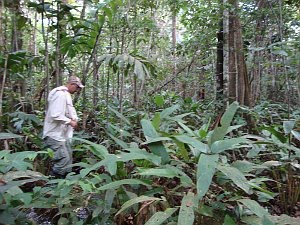
View of natural tropical forest canopy absorbing carbon
Why conservative? There is ample scientific support for much higher carbon sequestration rates by tropical trees. For example, Reforest the Tropics is an applied research program in Costa Rica demonstrating climate change mitigation through sustainable farm forestry. Using a 40 year base line they suggest that a natural tropical forest can sequester between 100 US tons to 160 US tons of carbon per acre (90.7 metric tons to 145 metric tons). This translates into 224 metric tons to 356 metric tons per hectare stored in a natural tropical forest over 40 years. Their research also suggests that a managed plantation of tropical trees will store as much as 800 US tons of CO2 per acre (725 metric tons). That translates into 1,792 metric tons per hectare. If one were to take 1,792,000 kg and divide by 40 years and then divide again by 1,250 tropical trees planted per hectare one would get 35.85 kg (79 lbs) per tree per year.

CO2 Tropical Trees bumber stickers are on cars all over the world!
CO2 Tropical Trees is actually relying on the most conservative estimates of carbon sequestration for its carbon neutral program. They are not alone in relying on those numbers. For example, Carbonify has a carbon calculator that is based on 22.6 kg or 50 lbs of carbon per tropical tree per year. Another example is the article by James Post, citing a 2005 study in Wikipedia that uses 22.6 kg or 50 lbs of carbon sequestration per tropical tree per year for the purpose of calculating carbon offsets. In conclusion all I can say is that every time someone funds the planting of a tropical tree with CO2 Tropical Trees or with Amazonia Reforestation, the very least they can expect from that tree is 22.6 kg or 50 lbs of carbon sequestered per year from our atmosphere. Given these facts and numbers people and institutions really don’t have any more excuses for not funding tree planting as an obvious partial solution to climate change.

How much carbon does a tropical tree sequester? (Part 1)

Dexter Dombro at experimental native tree plantation
Some people have asked me what evidence there is to support the claim by CO2 Tropical Trees that the average tropical tree will sequester 22.6 kg or 50 lbs of carbon per year. First off, let me stress that this is affected by location, soil type, rainfall and species. Having said that, most tropical trees located within 15 degrees northern and southern latitude of the equator do indeed sequester significant amounts of carbon dioxide (CO2) from the atmosphere, something that is supported by numerous studies and ongoing research. In this 2-part article I will offer some calculations in support of the efficiency of tropical plantation trees as a method of carbon sequestration. I will base my calculations on industry standard hectares (an area measuring 100 meters by 100 meters, or 2.47 acres) with 1,250 trees planted per hectare, later culled back to 600 trees per hectare.

Dexter Dombro with 11 month old tropical tree plantation
In an article entitled “Carbon sequestration in tropical agroforestry systems”, Alain Albrecht and Serigne T. Kandji of the Institut de Recherche pour le Développement found that the carbon sequestration potential of tropical agroforestry systems produced a median sequestration value of 95 metric tons (104 US tons) per hectare per year. Taking into account the variables of location, soil type, rainfall and species it can be as high as 228 metric tons (251 US tons) per hectare. Assuming a median of 95,000 kg divided by 1,250 trees per hectare one would get 76 kg (167 lbs) per tree. In a managed plantation trees are often culled back to about 600 trees per hectare, which would result in 158 kg (348 lbs) per tree per year. These numbers support the cubic meter increase of woody biomass observed in growing locations with excellent conditions. Please note that managed plantations generally produce 20 to 30 times more wood than do natural forests, resulting in higher carbon sequestration rates per hectare.

Natural tropical forest is less dense than plantation forests
Studies cited in Science Daily show that natural African tropical forests absorb about 600 kg (1,323 lbs) of carbon per hectare per year. If you take 600 kg by 25 times more wood per hectare in a plantation setting, you get 15,000 kg (33,000 lbs) per hectare per year divided by 600 plantation trees per hectare, which results in 25 kg (55 lbs) of carbon sequestered per tree per year. I should also mention that one of the species CO2 Tropical Trees plants is Acacia mangium, a recognized nitrogen-fixing tree (NFT). Studies like “Greater Soil Carbon Sequestration under Nitrogen-fixing Trees Compared with Eucalyptus Species” published by Ecosystems, a Springer publication, show that NFT’s sequester more carbon in the soil than do other types of tropical trees.

Dilmun Dombro admiring rapid growth of 2 year old Acacia mangium
One problem in the literature is the vastly varying time-lines on which research has been based. Both Amazonia Reforestation and CO2 Tropical Trees rely on a 10 year cycle from seed to mature tree for all of their calculations. This fact further enhances their credibility on the issue, because in the study “Carbon sequestration through afforestation: Role of tropical industrial plantations” their methodology of using a 10 year cycle to maximize woody biomass growth and carbon sequestration is supported. The article confirms that once tropical trees reach maturity their effectiveness for carbon sequestration purposes declines. That means that using a 10 year cycle maximizes the carbon sequestration efficiency of their tropical tree plantations. This analysis of studies and methodologies will continue in Part 2 of this article (next Post).