Showing posts with label co2. Show all posts

Friday, June 3, 2016

Grouped VCS carbon cerrtification in Vichada


by Dexter B. Dombro

I am very proud to share this excellent video of our plantation's participation in a grouped Verified Carbon Standard (VCS) certification process led by the Fundación Natura (Natura Foundation) in Colombia. Four members of our local forestry association (AGAF), which includes us at La Pedregoza, started the process last year. All of our baseline work has now been accepted, so we should shortly have a carbon certification which will allow our carbon offsets to be bought and sold on various carbon exchanges around the world.

Check out:  https://www.youtube.com/watch?v=R_lAwqgsF8E

Our CO2 Tropical Trees program is also gaining ground with small business owners, because we help them to accumulate carbon offsets over time for only $100 a month. The program plants only native tree species that in turn help to conserve biodiversity and to create wildlife corridors in strategic areas. Whenever possible, our planting focuses on the restoration of degraded areas, using native vegetation. That means that small business participants in the program are not only reducing or eliminating their carbon footprint, they are also helping to conserve biodiversity at the same time.

We continue to urge everyone to check in on CO2 Earth, which posts monthly atmospheric carbon readings from the Mauna Loa Observatory in Hawaii. The readings are not a pretty picture, with the 400 ppm ceiling broken some time ago, a ceiling some scientists feel may put us past the point of no recovery. However, we remain undaunted and continue to plant trees as a proactive way of fighting climate change. Check out the numbers for April 2016 at Mauna Loa, where there is no industry in mid-Pacific:

 
 To contact us at CO2 Tropical Trees you can send an e-mail to dexter at co2tropicaltrees dot com. Thanks!
 

Sunday, December 15, 2013

Understanding Tropical Soils: Part 1


by Dexter B. Dombro


Tropical tree plantation in sandy acidic soil.
Tropical forests are the lungs of our planet. 95% of all tree-based carbon sequestration occurs in the tropics, primarily between both 15° northern and 15° southern latitudes from the equator. The huge forests of Canada, Russia and Scandinavia and other temperate zones only account for 5% of tree-based carbon capture. This means that the decline of tropical forests is a huge cause of climate change. Many studies show that tropical deforestation emits greenhouse gases (GHG) and may well be the leading cause of desertification of the Earth. All trees play important roles in removing CO2 from the atmosphere, but also other dangerous contaminants. They help hold ground water and thanks to the process of transpiration are crucial for cloud seeding and the maintenance of global rainfall patterns. Needless to say, forests also account for 90% of terrestrial biodiversity, making them essential habitats for life on our planet.

Imagine transpiration being like tree sweat.
However, planting trees, especially tropical trees, involves more than just sticking a seedling in the ground. Tropical soils are often poor and acidic, in large part due to millennia of torrential rains that have leached the nutrients and organic material out of the soul, a process called lixiviation. For example, the grasslands of eastern Colombia (llanos orientales) and Venezuela have soils that are mainly composed of sand, ferrous oxide gravels and some clay. Similar conditions exist in large parts of Brazil and in the Amazon basin. This is why Amazon deforestation is such a huge problem: poor people cut down trees to grow subsistence crops, collect one harvest and then find that the soil is depleted, so they repeat the process, cutting down more rainforest. Unfortunately, this is the definition of insanity, doing the same thing over and over again, expecting different results each time.

Tropical deforestation
I don’t want to bore you, but it is important to understand two key issues involving tropical soils. The first issue is acidity, measured in a logarithmic scale from 1 to 14, with a pH below 7 being acidic, while a pH over 7 is alkaline. Logarithmic means that each number on the scale is either 10 times more acidic or 10 times more alkaline than the previous number. A pH of 7 is considered neutral and is the value of pure water. Most plants do very well in neutral soils. However, the majority of tropical soils are acidic, which means that native trees and plants have had to adapt to acidic soil conditions. For example, the soil at La Pedregoza in the Orinoco River basin of Colombia has an average pH of 5.9, meaning it is 90 times more acidic than pure water. The traditional agricultural solution to soil acidity is to dump tons of lime on the soil, in order to achieve a more neutral pH, without regard to the cost or the damage done to micro-fauna.

Cation Exchange Capacity or CEC
The second issue is something called the cation exchange capacity or CEC of the soil. For simplicity’s sake this is best described as the capacity of the soil to retain nutrients, be that organic material, micro-fauna or fertilizers. CEC is measured on a scale of 0 to 50, with 0 being soil that has complete filtration or lixiviation of any nutrients, making for rapid drainage with no retention of any kind. In contrast, soil with a CEC of 50 is solid rock or hard clay, which does not allow for drainage, causing plants and their roots to drown. In the case of tropical soils the majority have a very low CEC. For example, the average effective CEC of soils at La Pedregoza is around 1, so pretty much total filtration of the soil with very little retention of nutrients, organic material or micro-fauna. This explains why rainforest trees are complete recyclers, drawing the majority of their requirements from the atmosphere and from the dead fall of leaves, branches and other organic matter inside the forest. They have very little dependence on the soil for their food requirements. Now you know why rainforest deforestation in the tropics produces such poor agricultural results.

Typical soil sample analysis from the Orinoco River basin. CIC is CEC in Spanish, while CICE means the  effective retention of the soil. Note the pH of the soil meaning it's very acidic in its natural state. Also note how poor the soil is in elements.
In Part 2 of this series of articles, I will address the most promising solution to the nutrient retention and acidity problem in tropical soils. That solution has positive implications for carbon sequestration, plant nutrition, enhanced agricultural and agroforestry production, is financially sustainable and has huge socio-economic development benefits in tropical regions. It is also 100% organic and natural, without any chemical or artificial elements.

Sunday, July 11, 2010

How much carbon does a tropical tree sequester? (Part 2)

Woody biomass is 50% carbon in tropical trees
Continuing from Part 1 (previous Post), let me cite some additional studies and methodologies. A Dutch study entitled “Estimation of Tropical Forest Biomass for assessment of Carbon Sequestration using regression models in remote sensing in Berau, East Kalimantan, Indonesia” by Irvin K. Samalca, Alfred de Gier and Yousif Ali Hussin, of the Department of Natural Resources at The International Institute for Geoinformation Science and Earth Observation confirms and shows that 50% plus of a tropical tree’s woody biomass is carbon. That means that fast growing tropical trees like those planted by CO2 Tropical Trees and Amazonia Reforestation, which reach maturity in just 10 years, are excellent carbon storage vessels.

Dexter Dombro observing biomass increase in 11 month old Eucalyptus trees
Let’s calculate this from a different perspective. We know from several studies  that the woody biomass of a tropical tree plantation can increase by at least 35 cubic meters plus (14,382 board feet) per hectare per year. Depending on the hardwood species, one cubic meter (424 board feet) of tropical hard wood can weigh from 600 kg to 1,200 kg (1,322 lbs to 2,645 lbs). Assuming 1 hectare of trees with a gain of 35 cubic meters of wood times a conservative average of 750 kg (1,653 lbs) per cubic meter, and you get 26,250 kg (57,871 lbs) per hectare per year. If at least half of that woody biomass is carbon, then one gets 13,125 kg (28,935 lbs) of carbon. Divide 13,125 kg of carbon by an average of 600 mature plantation trees (after culls) and one gets 22.6 kg (50 lbs) per tree, the number used by CO2 Tropical Trees.

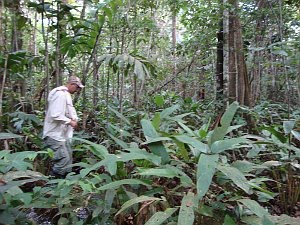
View of natural tropical forest canopy absorbing carbon
Why conservative? There is ample scientific support for much higher carbon sequestration rates by tropical trees. For example, Reforest the Tropics is an applied research program in Costa Rica demonstrating climate change mitigation through sustainable farm forestry. Using a 40 year base line they suggest that a natural tropical forest can sequester between 100 US tons to 160 US tons of carbon per acre (90.7 metric tons to 145 metric tons). This translates into 224 metric tons to 356 metric tons per hectare stored in a natural tropical forest over 40 years. Their research also suggests that a managed plantation of tropical trees will store as much as 800 US tons of CO2 per acre (725 metric tons). That translates into 1,792 metric tons per hectare. If one were to take 1,792,000 kg and divide by 40 years and then divide again by 1,250 tropical trees planted per hectare one would get 35.85 kg (79 lbs) per tree per year.

CO2 Tropical Trees bumber stickers are on cars all over the world!
CO2 Tropical Trees is actually relying on the most conservative estimates of carbon sequestration for its carbon neutral program. They are not alone in relying on those numbers. For example, Carbonify has a carbon calculator that is based on 22.6 kg or 50 lbs of carbon per tropical tree per year. Another example is the article by James Post, citing a 2005 study in Wikipedia that uses 22.6 kg or 50 lbs of carbon sequestration per tropical tree per year for the purpose of calculating carbon offsets. In conclusion all I can say is that every time someone funds the planting of a tropical tree with CO2 Tropical Trees or with Amazonia Reforestation, the very least they can expect from that tree is 22.6 kg or 50 lbs of carbon sequestered per year from our atmosphere. Given these facts and numbers people and institutions really don’t have any more excuses for not funding tree planting as an obvious partial solution to climate change.

How much carbon does a tropical tree sequester? (Part 1)

Dexter Dombro at experimental native tree plantation
Some people have asked me what evidence there is to support the claim by CO2 Tropical Trees that the average tropical tree will sequester 22.6 kg or 50 lbs of carbon per year. First off, let me stress that this is affected by location, soil type, rainfall and species. Having said that, most tropical trees located within 15 degrees northern and southern latitude of the equator do indeed sequester significant amounts of carbon dioxide (CO2) from the atmosphere, something that is supported by numerous studies and ongoing research. In this 2-part article I will offer some calculations in support of the efficiency of tropical plantation trees as a method of carbon sequestration. I will base my calculations on industry standard hectares (an area measuring 100 meters by 100 meters, or 2.47 acres) with 1,250 trees planted per hectare, later culled back to 600 trees per hectare.

Dexter Dombro with 11 month old tropical tree plantation
In an article entitled “Carbon sequestration in tropical agroforestry systems”, Alain Albrecht and Serigne T. Kandji of the Institut de Recherche pour le Développement found that the carbon sequestration potential of tropical agroforestry systems produced a median sequestration value of 95 metric tons (104 US tons) per hectare per year. Taking into account the variables of location, soil type, rainfall and species it can be as high as 228 metric tons (251 US tons) per hectare. Assuming a median of 95,000 kg divided by 1,250 trees per hectare one would get 76 kg (167 lbs) per tree. In a managed plantation trees are often culled back to about 600 trees per hectare, which would result in 158 kg (348 lbs) per tree per year. These numbers support the cubic meter increase of woody biomass observed in growing locations with excellent conditions. Please note that managed plantations generally produce 20 to 30 times more wood than do natural forests, resulting in higher carbon sequestration rates per hectare.

Natural tropical forest is less dense than plantation forests
Studies cited in Science Daily show that natural African tropical forests absorb about 600 kg (1,323 lbs) of carbon per hectare per year. If you take 600 kg by 25 times more wood per hectare in a plantation setting, you get 15,000 kg (33,000 lbs) per hectare per year divided by 600 plantation trees per hectare, which results in 25 kg (55 lbs) of carbon sequestered per tree per year. I should also mention that one of the species CO2 Tropical Trees plants is Acacia mangium, a recognized nitrogen-fixing tree (NFT). Studies like “Greater Soil Carbon Sequestration under Nitrogen-fixing Trees Compared with Eucalyptus Species” published by Ecosystems, a Springer publication, show that NFT’s sequester more carbon in the soil than do other types of tropical trees.

Dilmun Dombro admiring rapid growth of 2 year old Acacia mangium
One problem in the literature is the vastly varying time-lines on which research has been based. Both Amazonia Reforestation and CO2 Tropical Trees rely on a 10 year cycle from seed to mature tree for all of their calculations. This fact further enhances their credibility on the issue, because in the study “Carbon sequestration through afforestation: Role of tropical industrial plantations” their methodology of using a 10 year cycle to maximize woody biomass growth and carbon sequestration is supported. The article confirms that once tropical trees reach maturity their effectiveness for carbon sequestration purposes declines. That means that using a 10 year cycle maximizes the carbon sequestration efficiency of their tropical tree plantations. This analysis of studies and methodologies will continue in Part 2 of this article (next Post).