Showing posts with label afforestation. Show all posts

Thursday, April 26, 2012

Collecting Native Tree Seeds


Bertoldo looking for Sassafras trees.
Reforestation / afforestation efforts often involve planting trees that have a proven history of commercial success, fast growth and ease of cultivation. This copies the same pattern that has seen biodiversity in crops decline around the world, as most agriculture revolves around a limited number of species. At La Pedregoza one of our objectives is to practice multispecies cultivation that includes native trees. The importance of this is obvious when one visits large teak plantations in Costa Rica, as they are usually devoid of insects, birds and local wildlife, because teak is a tree from south Asia that is not part of local niche habitats.

How do I get up this Sassafras?
At La Pedregoza we rapidly focused in on the vast variety of native tree species to be found in the Orinoco River basin of Vichada, Colombia. Many of these trees have exotic qualities, be that wood, termite resistance, fruits, nuts, oils, resins or natural medicines. We soon discovered that some native trees appear to be fast growing, but that there is virtually no data available on seed germination, propagation, planting methods or best cultivation practices. During this process we learned that many species of native trees are listed in the red books of the International Union for the Conservation of Nature (IUCN) as endangered, vulnerable or threatened.

Acosmium nitens test cultivation.
Amazonia Reforestation and CO2 Tropical Trees programs at La Pedregoza are based on a desire to preserve biodiversity on our planet. Some 90% of terrestrial biodiversity lives in forests. Many of those animals are niche dependent, for example everyone learns in school about Koala bears needing eucalyptus trees and giant Pandas depending on bamboo forests. At La Pedregoza we have birds, amphibians and mammals that depend on certain types of native trees for food, shelter and nesting areas.  Planting native tree species soon became not just an objective for our reforestation efforts and for our Reserva Natural La Pedregoza, but a passion.

Bertoldo climbing Salivón tree.
Due to our wet and dry seasons we are able to collect most of our native tree seeds in the second half of the dry season and the early part of the wet season. Most trees flower in the first half of the dry season, so the best time for us to collect most native tree seeds is predictable. This does not mean it is an easy process. Monkeys, macaws, parrots and ants compete with us for the fruits and seeds of several trees that are on the endangered list. Once the rains start we experience flooding in the rainforest, with seeds falling into the water and washing away. Climbing the trees can be dangerous, as many seeds can only be found high in the rainforest canopy. This makes the seed collection process expensive, time consuming and often disappointing when seeds have already been lost.
 
Endangered Ocotea cymbarum seeds.
This March and April of 2012 our foreman, Bertoldo Aldana, our plantation administrator, Oscar Forero Azabache, and I were able to collect native trees seeds from a variety of species. Some of what we collected includes 3000 Congrio seeds (Acosmium nitens), 1100 endangered Sassafras seeds (Ocotea cymbarum), 6000 Saladillo blanco (Vochysia obscura), 1200 latex producing Pendare or Salivón seeds (Parahancornia oblonga), 800 threatened latex producing Madroño seeds (Rheedia madrunno), and several hundred Moriche palm seeds (Mauritia flexuosa) to plant for use by local indigenous artisans. 

Extracting Salivón seeds from fruits.
Once the seeds are collected various things happen. First off we maintain a photographic record of the seeds and their appearance for future reference. Next we do various experimental germination trays, so see what works best (direct in soil, soaked for 24 or 48 hours, fired to crack seed cover, rubbing sand paper on germination end of seed etc.). This data is of course recorded. Once the seeds sprout we transfer them to planting bags containing soil that has been treated for bacteria and fungi.  Usually larger than normal planting bags are used, because we do not fully understand the type of early root system these native trees produce, so that is something we monitor. The seedlings are then placed in the tree nursery where we observe their early growth. This is usually an indication of root development as well, which in turn lets us determine how soon the seedling can be transferred to the open field. While in the nursery the seedlings are provided with some shade, but we try to remove the shade once growth starts, so that the little trees can better withstand the conditions they will encounter once planted in the field.

Saladillo blanco sprouting table.
Native trees pose special problems for us at La Pedregoza, because in Vichada’s Orinoco River basin many of these trees are adapted to inundation forest and low lying area conditions. That means they may require annual flooding. It is hard to do soil preparation in low lying areas, as the soil may be very wet and soft, making mechanical soil preparation difficult. It also affects how we apply lime to balance soil pH, fertilizer and organic material, as flooding may wash those substances away before the tree can make use of them. Part of what we do is to plant native trees in both low lying areas, and in areas with better drainage. For example, even though Congrio (Acosmium nitens) typically grows in the inundation forest, we have experienced better growth results with this species in less humid areas, than in low-lying inundation areas. Once again all of this data is collected and tracked.

Ripe Acosmium nitens seed pods.
Our long term goal to become a seed bank for native tree species is shared with the Omacha Foundation and with Europe’s Tree-Nation. Our common goal is to conserve species that are endangered, vulnerable or threatened. It is our believe that if we can commercialize those species, by providing access to seeds, germination and planting instructions and information on growth expectations and carbon sequestration, then other plantations will start to cultivate these species. That will reduce or remove the pressure those species experience in natural forests, reduce illegal logging and allow for the species to recover over time. Commercializing a species may appear to some to be an unwelcome development, but it is a process that is most likely to prevent a species’ extinction and to have an impact on maintaining and conserving biodiversity.

Congrio seeds are like apple seeds.
Dexter B. Dombro is one of the founders of Amazonia Reforestation, CO2 Tropical Trees and of the Reserva Natural La Pedregoza in Vichada, Colombia. La Pedregoza is one of the featured plantations within Tree-Nation. Dexter is a member of the IUCN’s World Commission on Protected Areas and is dedicated to biodiversity conservation in the Orinoco River basin. The La Pedregoza plantation was founded in 2007.


Monday, April 16, 2012

Saladillo blanco – a promising native tree!

Saladillo blanco seeds
For the 2012 planting season Amazonia Reforestation is planting 5 hectares of Vochysia obscura of the Vochysiaceae family at its La Pedregoza plantation. Known locally as Saladillo blanco this tropical tree has many of the characteristics foresters look for. It is fast growing to harvestable maturity (10 to 15 years). It can be planted in marginal soils with high pH content. It does well in low lying areas subject to inundation, allowing for the economic use of areas that do not have good drainage. Best of all, it has a trunk that grows straight and tall, producing fine wood with great commercial acceptance.

Saladillo blanco flowers
The seeds can be collected from wild trees, providing foresters with the opportunity to select the trees with the best apparent genetics. Unlike some other native tree species, the seeds are abundant and do not attract as many animals and birds, making their collection easier. Foresters generally select from which trees they wish to collect seeds when the trees have their bright yellow flowers during the dry season in the Orinoco River basin. The flowers make the trees easy to distinguish and mark for later seed collection activities. The show of flowers also allows the forester to determine just how abundant seed production will be in each tree.

Sprouting tables are used in the tree nursery, with high germination rates observed for the Saladillo blanco. Once the sprout is thumb tall it is transplanted into a planting bag filled with treated soil and placed in the nursery. Like many other tropical trees Vochysia obscura sets deep roots, so forestry engineers determine when the sapling is ready to be transplanted into the field. While the seedlings are in the nursery plantation tractors prepare the soil, deep plowing to a depth of 75 cm (30 inches), which allows the root to go deep quickly. At planting in moist areas tree planters add lime and special forestry fertilizer for best growth results.

Saladillo blanco tree
Thanks to their straight trunks, these trees reach 20 m (65 feet) in height and some 55 cm (22 inches) in diameter at breast height when they are ready to be harvested. The tree has been planted as an ornamental, but finds its greatest use as cut lumber and as wood for handicrafts, which explains its folkloric history in the llanos orientales or great plains of eastern Colombia. Several authors have recommended this tree for reforestation and afforestation projects, including Luis Enrique Acero Duarte in his “Plantas Utiles de la Cuenca del Orinoco” or “Useful Plants of the Orinoco River basin”.

Monday, May 2, 2011

10 Reasons Why Planting Tropical Trees is a Good Investment

1. For lumber.  Most people realize that if plantation wood is not available, then lumber will be cut from existing natural rain forest.  It is worth repeating that it is better to have one’s coffee table made out of plantation wood, and not out of old growth tropical forest. 

Acacia mangium plantation2. For profit. If afforestation and reforestation projects are not profitable, they are not  financially   sustainable. The fuzzy logic of many NGO’s on this issue is proven wrong by the reality on the ground. Humans need lumber resources for furniture, construction, boat building, farming, renewable energy and numerous other applications. Simply planting trees and then expecting them not to face the same problems forests have faced in the past is ridiculous. This means that profitable plantations can become the buffer that allows natural reserves and parks to protect biodiversity and natural forests. Profit is also boosted by demand, as humans give rabbits a run for procreativity. Don’t believe it? China now has more than 1.3 billion people, with India snapping at China’s heels, and with all of those people needing building materials, furniture, wood products, paper and fuel.

Native tree planting3. For biodiversity. Green companies like Amazonia Reforestation have programs to collect seeds and propagate native tree species that have been recklessly logged in the past. This is a challenging and expensive process, as there is often little information on germination, planting times, or even when or how to collect seeds. Propagation is challenged by the preference of many tropical trees to grow in social settings, in low-lying areas, or in areas subject to inundation. These factors make soil preparation, fertilization and forest management difficult. The founders of Amazonia Reforestation, members of the IUCN`s World Commission on Protected Areas, have created a natural reserve for this purpose, as an additional means of preserving biodiversity, and to inspire others to follow their lead.

Eucalyptus pellita plantation4. For expanded wildlife habitat. Many animals are niche specific. This means that if native tree species   are decimated, it has a direct impact on biodiversity and on the survival of many species of wildlife. By planting native tree species, responsible companies can expand wildlife habitat, while still providing lumber resources for human use. Amazonia Reforestation does this in both its natural reserve and in its plantation areas.

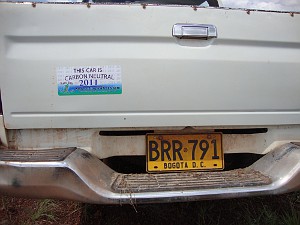
CO2 Tropical Trees sticker5. For carbon sequestration. It is scientific fact that tropical trees are very effective at carbon sequestration. Each fast growing tropical plantation tree sequesters as much as 50 lbs or 22.6 kg of carbon a year. Well over 50% of their woody biomass is carbon. Planting tropical trees is a major method of dealing with atmospheric carbon, which has gone from 350 ppm in 1985 to 393 ppm in April 2011 (Mauna Loa Observatory, Hawaii). CO2 Tropical Trees promotes that fast growing tropical trees are most effective at carbon sequestration within the first 10 years of their lives, a fact that jives well with human lumber requirements, leaving the carbon trapped in the wood for decades after harvest.

Fast growing Acacia mangium6. For cloud seeding. The natural process of transpiration by forests creates cloud in the atmosphere  that in turn bounces solar rays back into space, thereby cooling the Earth. Deforestation causes the opposite effect, including desertification of the planet and a hotter climate. An investment in tropical trees therefore offers up a double whammy against climate change and global warming thanks to cloud seeding and carbon capture.

Cashew in acidic soil7. For land reclamation. Many plantation species do well in infertile tropical soils, fixing nitrogen and depositing carbon in the soil, building up the soil so that after a harvest other more exotic and delicate species can be planted. Tropical tree planters like Amazonia Reforestation and CO2 Tropical Trees choose Acacia mangium, Azadirachta indica (Neem) and other legume family trees for nitrogen fixing, Eucalyptus pellita for water retention and wind breaks, Pinus caribaea, Caraipa llanorum (Saladillo) and Anacardium occidentale (cashew ) for acidic soils, to name a few. All of these tropical trees are planted with the long term goal of building up the soil, removing pollutants from the air, preventing erosion and allowing improved use of the soil in the future.

Tree planting boosts development8. For socio-economic development. Tropical trees provide local communities with more than just  some jobs in the lumber industry. They also allow for the creation of spin-off industries in developing countries, including apiculture, tannins and dyes, insecticides and fungicides, repellents and toxins, fruits and nuts, medicinal and naturopathic products, arts and crafts, foods and liquors, gums and adhesives, resins and varnishes, latex and oils, boat building and musical instruments, eco-tourism and adventure tourism, fuel and charcoal, animal fodder and protection, as well as agroforestry, permaculture and analog forestry opportunities. More people around the globe with disposable incomes helps to increase demand for tropical hardwoods.

Reserva Natural La Pedregoza9. For renewable energy. Many countries now require that power generation involve a significant percentage of alternative energy. Solar, wind and water energy are not always practical or available. That leaves biomass as an additional option. Biomass can be almost carbon neutral, as it only releases what it absorbed from the atmosphere in the first place, which is better than the steady addition of atmospheric CO2 caused by hydrocarbons like petroleum and coal. Many fast growing plantation species have high calorific values, which when compressed into wood pellets and similar products can rival coal for kcal (kilocalorie) output.


10. For afforestation and reforestation. At present, people worldwide are only planting 10% of the trees we are harvesting, burning or removing on an annual basis. This is clearly not sustainable, as evidenced by climate change, desertification and loss of biodiversity. This in turn has a direct impact on the human spirit, on our health and on the survival of our planet. Green investors plant trees for a better world and because it is low risk but high return.